
Gerhard Sengle
FM | Department of Pediatric and Adolescent Medicine (UHC)
Prof. Dr. Gerhard Sengle
Associated Member
Research Areas
ECM Architecture & Growth Factor Dysregulation
Our research explores how defects in the extracellular matrix disrupt growth factor signaling, leading to connective tissue disorders in children such as cutis laxa, systemic sclerosis, and early aortic aneurysms.
Research Focus
Our research aims to understand how defects in the extracellular matrix (ECM) contribute to the onset and progression of pediatric connective tissue disorders. The ECM provides not only structural support but also acts as a critical regulator of cell signaling by controlling the bioavailability and spatial distribution of growth factors such as TGF-β and BMPs. Disruptions in ECM integrity can lead to dysregulated signaling, resulting in severe pathological outcomes including abnormal skin and bone development, fibrosis, muscle weakness, and life-threatening vascular diseases such as early aortic aneurysms.
We combine molecular biology, biochemistry, and advanced imaging techniques with in vitro and in vivo disease models to dissect the underlying pathomechanisms. By linking ECM architecture to growth factor regulation, we aim to reveal how structural ECM defects translate into tissue dysfunction. Our integrative approach bridges basic molecular mechanisms with translational research, providing new insights into the molecular determinants of connective tissue homeostasis and their dysregulation in disease.
Understanding how the ECM architecture controls the bioavailability of growth factors is crucial to unravel the molecular causes of connective tissue disorders and developing precise treatments for affected patients.
Our Goals
Our ultimate goal is to understand how the extracellular matrix orchestrates tissue homeostasis and how its disruption leads to disease. By identifying the molecular mechanisms that control growth factor bioavailability, we aim to uncover new biomarkers and therapeutic targets for pediatric connective tissue disorders.
A key focus is to dissect how specific ECM components interact with and sequester signaling molecules such as TGF-β and BMPs, and how these interactions are altered in disease. We use genetic mouse models, patient-derived cells, and protein biochemistry to connect molecular defects to tissue-level phenotypes. This integrative approach allows us to capture both local and systemic effects of ECM dysfunction.
In the long term, we strive to translate our discoveries into clinical benefit by enabling earlier diagnosis, personalized risk assessment, and targeted treatment strategies for patients. Our research contributes to collaborative initiatives such as FOR2722 on musculoskeletal disorders, TRR259 aortic disease, as well as FIBRO-NET fibrosis which bring together multidisciplinary expertise in ECM biology, immunology, and cardiovascular research. Together, we work towards a deeper understanding of tissue biology and the development of innovative therapies that can improve the quality of life for affected children and their families.
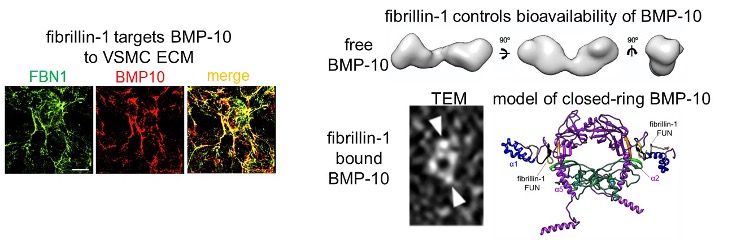
(Left) Assembled fibrillin-1 fibers target BMP-10 growth factors to the ECM microenvironment of VSMCs. (Right) Single particle electron microscopy (EM) shows that the BMP-10 prodomain-growth factor complex adopts an open boomerang shape. Upon binding to fibrillin-1 a closed ring-shape is induced that confers latency to the growth factor. Molecular docking model shows lateral binding of two fibrillin-1 molecules to the BMP-10 prodomain arms. In this closed ring-shape conformation access of receptors to the GF moiety (green) is blocked.
Key Publications
- Spanou CES, Yang C, Godwin ARF, Morosky S, Anbalagan A, Lütke S, Mörgelin M, Marcous F, Aziz U, Wohl AP, Jabeen I, Koch M, Jowitt TA, Roman BL, Tarakanova A, Baldock C, Sengle G. Prodomain processing controls BMP-10 bioactivity and targeting to fibrillin-1 in latent conformation. FASEB J. (2025) 39, e70373.
- Spanou CES, Wohl AP, Doherr S, Correns A, Sonntag N, Lütke S, Mörgelin M, Imhof T, Gebauer JM, Baumann U, Grobe K, Koch M, Sengle G. Targeting of bone morphogenetic protein complexes to heparin/heparan sulfate glycosaminoglycans in bioactive conformation. FASEB J. (2023) 37, e22717.
- Adamo CS, Beyens A, Schiavinato A, Keene DR, Tufa SF, Mörgelin M, Brinckmann J, Sasaki T, Niehoff A, Dreiner M, Pottie L, Muiño-Mosquera L, Gulec EY, Gezdirici A, Braghetta P, Bonaldo P, Wagener R, Paulsson M, Bornaun H, De Rycke R, De Bruyne M, Baeke F, Devine WP, Gangaram B, Tam A, Balasubramanian M, Ellard S, Moore S, Symoens S, Shen J, Cole S, Schwarze U, Holmes KW, Hayflick SJ, Wiszniewski W, Nampoothiri S, Davis EC, Sakai LY, Sengle G*, Callewaert B*. EMILIN1 deficiency causes arterial tortuosity with osteopenia and connects impaired elastogenesis with defective collagen fibrillogenesis. Am J Hum Genet. (2022) 109, 2230-2252.*Shared corresponding and last authors
- Furlan AG, Spanou CES, Godwin ARF, Wohl AP, Zimmermann LA, Imhof T, Koch M, Baldock C, Sengle G. A new MMP-mediated prodomain cleavage mechanism to activate bone morphogenetic proteins from the extracellular matrix. FASEB J. (2021) 35, e21353.
- Köhler A, Mörgelin M, Gebauer JM, Öcal S, Imhof T, Koch M, Nagata K, Paulsson M, Aumailley M, Baumann U, Zaucke F, Sengle G. New specific HSP47 functions in collagen subfamily chaperoning. FASEB J. (2020) 34, 12040-12052.
Prof. Dr. Gerhard Sengle
Associated Member