
Stephanie A. Fernandes
Max Planck Institute for Biology of Ageing

Dr. Stephanie A. Fernandes
Principal Investigator
Research Areas
Muscle Metabolism and Ageing
Skeletal muscle makes up nearly half our body mass and coordinates movement and posture. Its health depends on mTORC1 signaling, which regulates building and recycling of cellular components, processes disrupted with ageing.
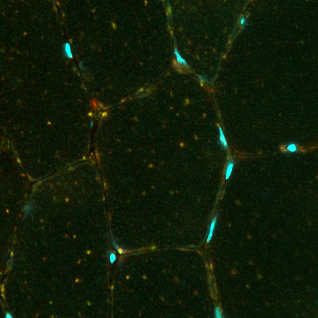
Research Focus
Skeletal muscle, comprising 40–50% of our body mass, is essential for movement, posture, and metabolism. Its unique structure, with multinucleated fibers and resident stem cells, enables contraction and regeneration. Each muscle cell type relies on anabolic (building) and catabolic (recycling) processes to maintain their function. Notably, dysregulation of these programs contributes to age-related muscle loss.
Central to the balance between anabolism and catabolism is mTORC1, a signaling hub that integrates environmental cues to coordinate metabolism. Our previous work shows that mTORC1 is not simply “on” or “off,” but can selectively regulate specific processes. This selective activity depends on its subcellular localization, which is dictated by the nutrient sources cells rely on. Cytoplasmic mTORC1, primarily activated by exogenous nutrients, promotes anabolic reactions such as protein synthesis. In contrast, lysosome-localized mTORC1, responsive to nutrients generated there, regulates catabolic processes, including lysosome biogenesis (Figure 1). We study how selective mTORC1 regulation affects muscle growth, maintenance, and repair.
Our lab explores how selective mTORC1 signaling is spatially organized across skeletal muscle cell types and how it changes with age. We aim to reveal how this control shapes muscle growth, regeneration, and lifelong muscle health.
Our Goals
We aim to understand how selective mTORC1 activity in distinct skeletal muscle cell types changes with age and how this affects muscle growth, maintenance, and regeneration. By uncovering the molecular factors that govern mTORC1 localization and function, we hope to identify mechanisms that can be targeted to preserve muscle health and mitigate age-related decline in muscle homeostasis.
Specifically, we seek to answer:
How is mTORC1 signaling coordinated across different skeletal muscle cell types?
Which intrinsic and extrinsic factors influence mTORC1 activity in these cells?
How does mTORC1 regulation change with age, and what are the consequences for the maintenance of muscle mass and tissue function?
To address these questions, we combine whole-cell and organelle isolation with high-throughput omics approaches, including proteomics, metabolomics, and proximome analyses, integrated with molecular biology, biochemistry, cell biology, and high-resolution imaging. We employ mouse models, established skeletal muscle cell lines, and iPSC-derived muscle cells to explore evolutionarily conserved regulatory mechanisms. This allows us to link the dynamics of mTORC1 signaling with functional outcomes in muscle growth and regeneration.
Ultimately, our research aims to translate mechanistic insights into strategies for healthy ageing, including the preservation of muscle mass, function, and regenerative capacity. By integrating molecular, cellular, and organismal approaches, our goal is to define targets and interventions that could maintain skeletal muscle health across the lifespan, reduce the burden of muscle loss, and improve overall quality of life.
Key Publications
1. Spatial and functional separation of mTORC1 signalling in response to different amino acid sources.
Fernandes, S. A., Angelidaki, D. D., Nuchel, J., Pan, J., Gollwitzer, P., Elkis, Y., Artoni, F., Wilhelm, S., Kovacevic-Sarmiento, M., & Demetriades, C. (2024). Nat Cell Biol. doi:10.1038/s41556-024-01523-7
2. Malonyl-CoA is a conserved endogenous ATP-competitive mTORC1 inhibitor.
Nicastro, R., Brohee, L., Alba, J., Nuchel, J., Figlia, G., Kipschull, S., Gollwitzer, P., Romero-Pozuelo, J., Fernandes, S. A., Lamprakis, A., Vanni, S., Teleman, A. A., De Virgilio, C., & Demetriades, C. (2023). Nat Cell Biol, 25(9), 1303-1318. doi:10.1038/s41556-023-01198-6
3. Decreased spliceosome fidelity and egl-8 intron retention inhibit mTORC1 signaling to promote longevity.
Huang, W., Kew, C., Fernandes, S. A., Lohrke, A., Han, L., Demetriades, C., & Antebi, A.
(2022). Nat Aging, 2(9), 796-808. doi:10.1038/s43587-022-00275-z
4. The Multifaceted Role of Nutrient Sensing and mTORC1 Signaling in Physiology and Aging.
Fernandes, S. A., & Demetriades, C. (2021). Front Aging, 2, 707372. doi:10.3389/fragi.2021.707372
5. Altered in vitro muscle differentiation in X-linked myopathy with excessive autophagy.
Fernandes, S. A., Almeida, C. F., Souza, L. S., Lazar, M., Onofre-Oliveira, P., Yamamoto, G. L., Nogueira, L., Tasaki, L. Y., Cardoso, R. R., Pavanello, R. C. M., Silva, H. C. A., Ferrari, M. F. R., Bigot, A., Mouly, V., & Vainzof, M. (2020). Dis Model Mech, 13(2). doi:10.1242/dmm.041244
Dr. Stephanie A. Fernandes
Principal Investigator