
Sabina Hillebrandt
FMNS | Department of Chemistry and Biochemistry | Humboldt Centre for Nano- and Biophotonics (UoC)
Jun.-Prof. Dr. Sabina Hillebrandt
Research Areas
Bioelectronics and Functional Materials
We are developing organic optoelectronic neurointerfaces for neuromodulation and neuroprotection. Our work bridges device engineering, materials science, and neuroscience to address aging-related neurodegenerative diseases.
Research Focus
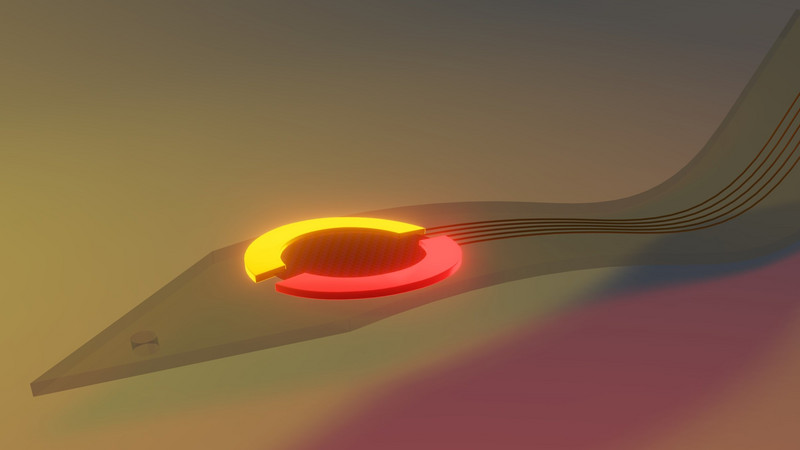
My research focuses on the development of optoelectronic technology for biomedical applications, with a particular emphasis on neuromodulation, neurointerfaces, and neuroprotection in aging-related neurodegenerative diseases. We work at the interface of organic electronics, materials science, chemistry, and neuroscience, combining fundamental device physics with translational biomedical research.
A central element of our work is the development of high-performance organic light-emitting diodes (OLEDs) tailored for biological environments. We investigate structure–property relationships, photophysics, and light–matter interactions in organic semiconductors to enable efficient, stable, and spectrally controlled light sources. These insights are translated into advanced device architectures, such as OLEDs integrated on CMOS backplanes and magnetoelectric platforms, enabling ultrahigh spatial resolution, wireless operation, and minimally invasive neuroimplants.
Using these technologies, my group develops optoelectronic implants for optogenetics, photobiomodulation, vision prosthetics, and brain–machine interfaces. In close collaboration with neuroscientists and clinicians, we validate these devices in advanced in vivo models of neurodegeneration, including Parkinson’s and Alzheimer’s disease, with the aim of understanding and modulating neural circuit dysfunction associated with aging.
By integrating optoelectronics with living systems, we aim to understand and protect the ageing brain, using light to precisely modulate neural function and explore new therapeutic strategies.
Our Goals
- The overarching goal of my research is to establish organic optoelectronics as a versatile and powerful platform for studying, modulating, and ultimately protecting neural circuits in aging and neurodegenerative disease. Supported by an ERC Starting Grant, my group is developing flexible, bidirectional OLED-based brain–machine interfaces that combine optical stimulation with optical readout of neural activity in a single implantable system.
- A key objective is to harness near-infrared and visible light delivered by OLEDs to induce neuroprotective effects through highly controlled photobiomodulation and optogenetic approaches. By integrating device engineering with molecular, cellular, and functional readouts, we aim to elucidate how precise optical stimulation can influence neuronal survival, plasticity, and network resilience during aging.
- Beyond technological innovation, my goal is to create experimental platforms that enable interdisciplinary collaboration across disciplines. These platforms will allow the investigation of age-related changes in neural circuits, the identification of early biomarkers of dysfunction, and the testing of targeted interventions in disease-relevant models. In the long term, this work aims to contribute to the development of more individualized and less invasive therapeutic strategies for neurodegenerative diseases.
Key Publications
1. Hillebrandt, S.; Moon, C.; Taal, A. J.; Overhauser, H.; Shepard, K. L.; Gather, M. C. High‐Density Integration of Ultrabright OLEDs on a Miniaturized Needle‐Shaped CMOS Backplane. Advanced Materials 2023, 2300578. doi.org/10.1002/adma.202300578.
2. Taal, A. J.*; Uguz, I.*; Hillebrandt, S.*; Moon, C.-K.*; Andino-Pavlovsky, V.; Choi, J.; Keum, C.; Deisseroth, K.; Gather, M. C.; Shepard, K. L. Optogenetic Stimulation Probes with Single-Neuron Resolution Based on Organic LEDs Monolithically Integrated on CMOS. Nat Electron 2023, 6 (9), 669–679. doi.org/10.1038/s41928-023-01013-y. (* = joint first authorship)
3. Butscher, J. F.; Hillebrandt, S.; Mischok, A.; Popczyk, A.; Booth, J. H. H.; Gather, M. C. Wireless Magnetoelectrically Powered Organic Light-Emitting Diodes. Sci. Adv. 2024, 10 (10), eadm7613. doi.org/10.1126/sciadv.adm7613.
4. Mischok, A.; Siegmund, B.; Roux, F. L.; Hillebrandt, S.; Vandewal, K.; Gather, M. C. Breaking the Angular Dispersion Limit in Thin Film Optics by Ultra-Strong Light-Matter Coupling. Nat Commun 2024, 15, 10529. doi.org/10.1038/s41467-024-54623-1.
5. Hillebrandt, S.; Keum, C.; Deng, Y.; Chavas, J.; Galle, C.; Hardin, T.; Galluppi, F.; Gather, M. C. High Brightness, Highly Directional Organic Light‐Emitting Diodes as Light Sources for Future Light‐Amplifying Prosthetics in the Optogenetic Management of Vision Loss. Advanced Optical Materials 2022, 2200877. doi.org/10.1002/adom.202200877.