

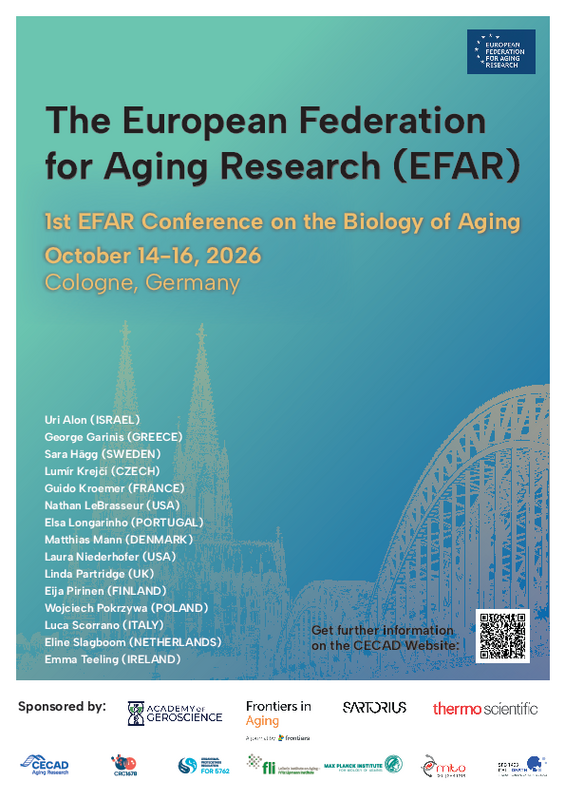
1st Conference of the European Federation for Aging Research (EFAR)
On the Biology of Aging
The newly founded European Federation for Aging Research (EFAR). Together with the German (DGfA), Dutch (DUSRA), Nordic (Nordic Aging), and British (BSRA) societies for aging research, we founded EFAR that aims to connect the community of aging researchers across Europe. Additional aging societies from countries across Europe are about to join as well. Our aim is to form a structure for scientific exchange, supporting young scientists entering the field, promote aging research and advance policy towards strengthening this area of research. We are open to members in the field of aging research from all European countries and would be delighted to have all members of the founding societies on board.
When & Where:
Date: 14th - 16th October 2026
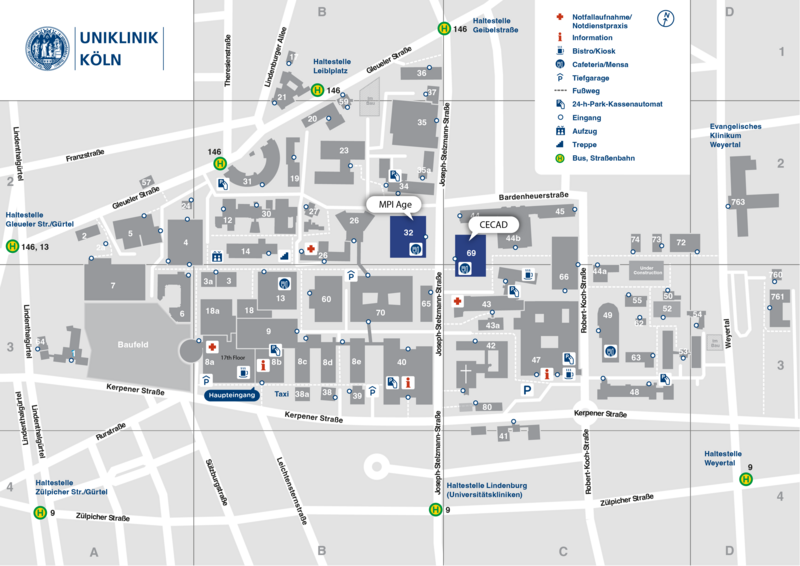
Venue: MPI for Biology of Ageing & CECAD Research Center, Cologne, Germany
Organisatory Guidelines
Poster:
Please bring a printed version of your poster to the conference.
Poster format: max. 841 × 1189 mm (A0), portrait orientation only.
You will receive necessary materials for attaching your poster to the
designated presentation walls at the registration desk.
The Poster session takes place in the CECAD building.
Posters have to be mounted by Wednesday, 14.10.2026, from 12:00 to 16:15 at the latest.
Posters have to be demounted by Thursday, 15.10.2026, until 15:00 at the latest
A detailed floor plan will be provided on the website and is also available at the registration desk during the conference.
Talk:
Time slots scheduled for different talks:
Selected by abstract: 10 minutes presentation and 5 minutes discussion
Invited speakers: 20 min presentation plus 5 minutes discussion
We kindly ask you not to extend your presentation time due to the tight schedule
Technical information for speakers:
Due to the tight schedule and the technical options of the MPI lecture hall, we would like to upload your presentations in advance on a central server.
Presentations where you use your own laptop should be an exceptional cases—that is, if not all of your presentation data can be fully transferred.
All presentations will be delivered using a Windows computer. If you wish to include videos in your presentation, please note that these cannot be played with sound.
We kindly ask that you to provide your presentations on a USB stick at the reception desk in advance of your session, if possible the previous day.
We will have Windows computers available at the reception desk where you can check whether your presentation plays as planned.
Due to the high demand, all presentations from the Max Planck Lecture Hall will be streamed via zoom to an additional seminar room in the CECAD building, which offers space for 50-60 people.
Your presentations will not be recorded, and your files will be deleted after the event.
If you have any questions, please feel free to contact the reception desk on-site or send us an email at cologne-efar[at]uni-koeln.de in advance.
Public Transport tickets:
Public transport ticket will be provided at the registration desk. They are for free for those who ordered a ticket during registration.
Meals and Drinks:
Participants have all meals and drinks covered during the breaks as outlined in the conference programm.
Registration
You can now register for the event in our Registration Tool:
https://uni-koeln.converia.de/frontend/index.php?sub=98
Registration is possible until August 10, 2026.
Conference fees are for:
- EFAR Member 160 €
- Non-EFAR Members 180 €
- PhD / Postdocs 170 €
Registration is mandatory.
Hotel Booking
Click on this link to find hotel recommendations via the booking tool by Kuoni Tumlare:
Program
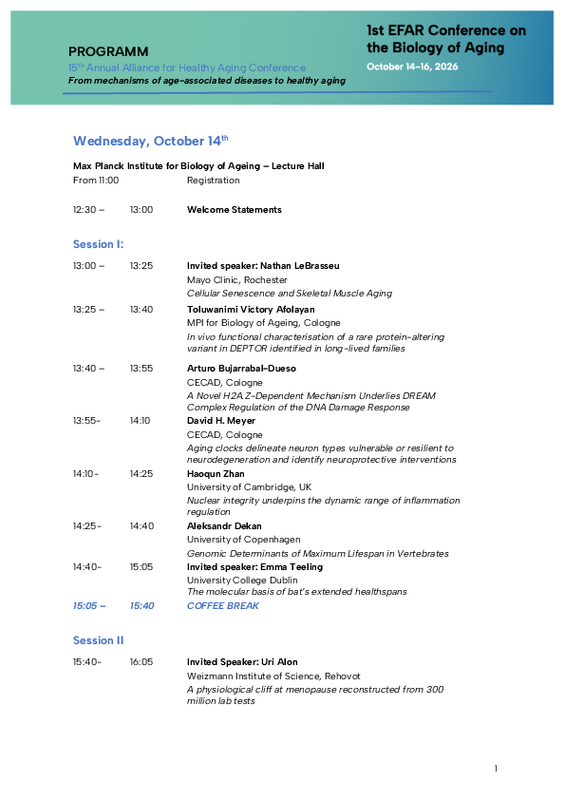
Wednesday, October 14th
| from 11:00 | Registration | ||
| 12:30 - 13:00 | Welcome | ||
| SESSION I | |||
| 13:00 - 13:25 | Invited Speaker | Nathan LeBrasseu, Mayo Clinic Rochester | Cellular Senescence and Skeletal Muscle Aging |
| 13:25-13:40 | Toluwanimi Victory Afolayan, Max Planck Institute for Biology of Ageing, Cologne | In vivo functional characterisation of a rare protein-altering variant in DEPTOR identified in long-lived families | |
| 13:40-13:55 | Arturo Bujarrabal-Dueso, CECAD, Cologne | A Novel H2A.Z-Dependent Mechanism Underlies DREAM Complex Regulation of the DNA Damage Response | |
| 13:55-14:10 | David H. Meyer, CECAD, Cologne | Aging clocks delineate neuron types vulnerable or resilient to neurodegeneration and identify neuroprotective interventions | |
| 14:10-14:25 | Haoqun Zhan, University of Cambridge | Nuclear integrity underpins the dynamic range of inflammation regulation | |
| 14:25-14:40 | Aleksandr Dekan, University of Copenhagen | Genomic Determinants of Maximum Lifespan in Vertebrates | |
| 14:40-15:05 | Invited Speaker | Emma Teeling, University College Dublin | The molecular basis of bat’s extended healthspans |
| 15:05-15:40 | COFFEE BREAK | ||
| SESSION II | |||
| 15:40-16:05 | Invited Speaker | Uri Alon, Weizmann Institute of Science, Israel | A physiological cliff at menopause reconstructed from 300 million lab tests |
| 16:05-16:20 | Peter de Keizer, University Medical Center Utrecht | PMLhigh, impaired-p53 scarred cells are a therapeutic target for healthy longevity | |
| 16:20-16:35 | Constantinos Demetriades, ERIBA/UMCG, Groningen | mTOR Ubiquitination in Ageing and Disease | |
| 16:35-16:50 | Joris Demmers, CECAD, Cologne | Transcription speed is controlled by mTOR via the super elongation complex | |
| 16:50-17:05 | Nikoleta Nikou, Universitat Autònoma de Barcelona | Novel Treatments to Mitigate Ovarian Aging and Follicle Loss | |
| 17:05-17:20 | Taiyu Ge, CECAD, Cologne | Vitamin B12 boosts H3K4me2 deposition to promote transcription recovery following DNA damage | |
| 17:20-17:45 | BREAK | ||
| 17:45-18:10 | Invited Speaker | George Garinis, University of Crete | DNA damage and Innate Immune responses in Health and Disease |
| 18:10-18:25 | Dax Houtkamp, Vrije Universiteit Amsterdam | Prolonged bed rest reduces PhenoAge despite marked physiological deconditioning | |
| 18:25-18:40 | Shoma Ishikawa, CECAD, Cologne | Non-cell-autonomous control of stress surveillance by telomere deprotection | |
| 18:40-18:55 | Maria Sol Jacome Burbano, CECAD, Cologne | A neonatal-like cardiac program underlies adult heart regeneration in the naked mole-rat | |
| 19:15-22:15 | POSTER SESSION |
Thursday, October 15th
| SESSION III | |||
| 9:00-9:25 | Invited Speaker | Elsa Logharino, University of Porto | The geroprotective role of the transcription factor FOXM1 |
| 9:25-9:40 | Lucia Lorenzo Rodriguez, CIMUS-USC, Universidade de Santiago de Compostela | Senomorphic effect of genetic and chemical partial reprogramming | |
| 9:40-9:55 | Helene Martini, Mayo Clinic, Rochester | Mitochondrial metabolism and epigenetic crosstalk in senescent cells | |
| 9:55-10:10 | Manuel Collado, CIMUS-USC, Universidade de Santiago de Compostela | The Last kiss: Apoptotic Secreted Factors Drive Cellular Senescence | |
| 10:10-10:25 | Julian Mutz, King's College London | Do mental disorders accelerate the pace of ageing? | |
| 10:25-10:50 | Invited Speaker | Laura Niederhofer, University of Minnesota | Senescent cells role in liver aging and disease |
| 10:50-11:30 | COFFEE BREAK | ||
| SESSION IV | |||
| 11:30-11:55 | Invited Speaker | Luca Scorrano, University of Padova | Fis1 Loss Drives Endothelial Senescence via Maladaptive Fatty-Acid Metabolism |
| 11:55-12:10 | Francesco Neri, University of Turin | Loss of regeneration and epigenetic drift of the intestinal stem cells during aging | |
| 12:10-12:25 | Katharina Papsdorf, Institute of Molecular Biology (IMB), Mainz | Lipid droplets in MUFA mediated longevity | |
| 12:25-12:40 | André Rendeiro, CeMM Research Center for Molecular Medicine, Vienna | Histological aging signatures enable inference of tissue-specific disease associations from blood | |
| 12:40-13:05 | Invited Speaker | Sara Hägg, Karolinska Institute, Stockholm | Tracking human aging for precision health |
| 13:05 -14:45 | LUNCH | ||
| SESSION V | |||
| 14:45-15:10 | Invited Speaker | Lumir Krejčí, Masaryk University, Brno | Regulation of Homologous Recombination |
| 15:10-15:25 | David Doupe, Durham University | The transcription factor Sob maintains intestinal stem cell homeostasis to delay aging | |
| 15:25-15:40 | Della David, Babraham Institute, Cambridge | Identification of a novel human extracellular chaperone promoting healthy ageing | |
| 15:40-15:55 | Oliver Tüscher, Martin Luther University Halle-Wittenberg (MLU) | TACR3 variant confers resilience to aging and Alzheimer's disease | |
| 15:55-16:10 | Dongryeol Ryu, Gwangju Institute of Science and Technology (GIST) | Discovery of a Circulating Myokine that Improves Systemic Function in Aged Mice | |
| 16:10-16:25 | Markus Schosserer, Medical University of Vienna | The role of the ribosomal RNA methyltransferase Nsun5 in mouse aging and development | |
| 16:25-16:40 | Payel Sen, National Institute on Aging | A single-cell multi-omic atlas decodes the regulatory logic of liver aging | |
| 16:40-17:05 | Invited Speaker | Wojciech Pokrzywa, International Institute of Molecular and Cell Biology in Warsaw (IIMCB) | Proteotoxicity-driven nucleolar transition integrates protein storage, ribosome biogenesis and cellular stress pathways |
| 17:15 – 18:15 | Members assembly | ||
| 19:15-22:30 | Speaker’s dinner (by invitation only) |
Friday, October 16th
| SESSION VI | |||
| 9:00-9:25 | Invited Speaker | Eija Pirinen, University of Oulu | Obesity-related remodeling of NAD+ metabolism in human adipocytes |
| 9:25-9:40 | Mirre Simons, The University of Sheffield | Suppression rather than activation of the integrated stress response (GCN2–ATF4) pathway extends lifespan in the fly | |
| 9:40-9:55 | Yossawat Suwanlikit, Robert and Arlene Kogod Center on Aging, Mayo Clinic, Rochester | DNA Methylation-Based Clonal Hematopoiesis Burden Associates with Structural Brain Atrophy | |
| 9:55-10:10 | Vakil Takhaveev, ETH Zürich | The Damage Code – Single-Nucleotide Maps of DNA Lesions Across the Ageing [Epi]Genome | |
| 10:10-10:25 | Danila Voronov, Leibniz Institute on Aging - Fritz Lipmann Institute (FLI), Jena | Shared molecular signatures between diapause II and aging in killifish Nothobranchuis furzeri suggest aging during diapause II | |
| 10:25-11:15 | COFFEE BREAK | ||
| 11:15-11:40 | Invited Speaker | Guido Kroemer, Université de Paris Cité | Immunosuppression by the geroprotein ACBP/DBI |
| 11:40-11:55 | Shibo Wei, Gwangju Institute of Science and Technology (GIST) | Localized NAD_ Replenishment Restores Metabolic Resilience and Mitigates Cardiac Injury after Myocardial Infarction | |
| 11:55-12:10 | Mauro Corrado, CECAD, Cologne | Suppression of T Cell–Driven Type I Interferons in Ageing Reveals Gut-Specific Vulnerability | |
| 12:10-12:35 | Invited Speaker | Eline Slagboom, Leiden University Medical Center | Lifestyle intervention effects in middle age monitored across omics layers and tissues; practical implications |
| 12:35-13:00 | Concluding remarks, Poster prizes |
Organizing committee
Björn Schumacher (Cologne, chair)
David Vilchez (Cologne)
Anne Schaefer (Cologne)
Morten Scheibye-Knudsen (Denmark)
Lene Rasmussen (Denmark)
Folkert Kuipers (Netherlands)
Joris Deelen (Netherlands)
Riekelt Houtkooper (Netherlands)
David Weinkove (UK)
Hartmut Geiger (Germany)
Helen Morrison (Germany)
Ira Milosevic (Portugal/UK)
European Federation for Aging Reserach
Interested in the European Federation for Aging Reserach?
If you want to become a member of the EFAR, please see: LINK
Venue
Max Planck Institute for Biology of Ageing
Joseph-Stelzmann-Str. 9B
50931 Cologne
Download here a map of the University Hospital campus.
(32) Max Planck Institute for Biology of Ageing
(69) CECAD Research Center
Sponsored by

EFAR Conference: More Than Just a Meeting – Uniting Aging Research Across Europe
Aging research in Europe is highly fragmented. To change this, the European Federation for Aging Research (EFAR) was established. Its goal is to unify research and promote collaboration, to create Europe-wide funding mechanisms, to put research findings into practice and to attract top researchers to geroscience.
Read more about EFAR’s vision and mission in this article in Nature Aging, written by CECAD speaker Björn Schumacher together with the EFAR founding members Morten Scheibye-Knudsen, Lene Juel Rasmussen and Folkert Kuipers.