
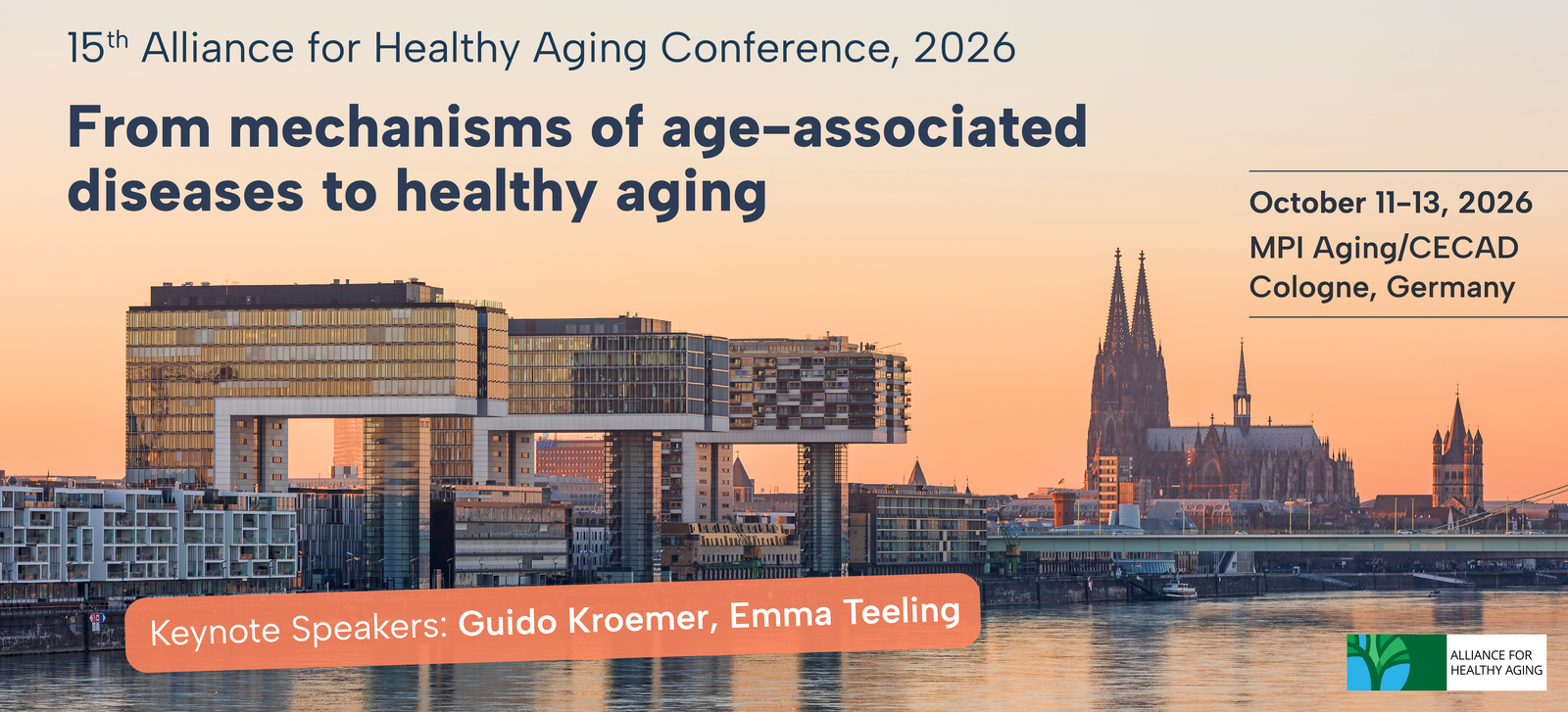
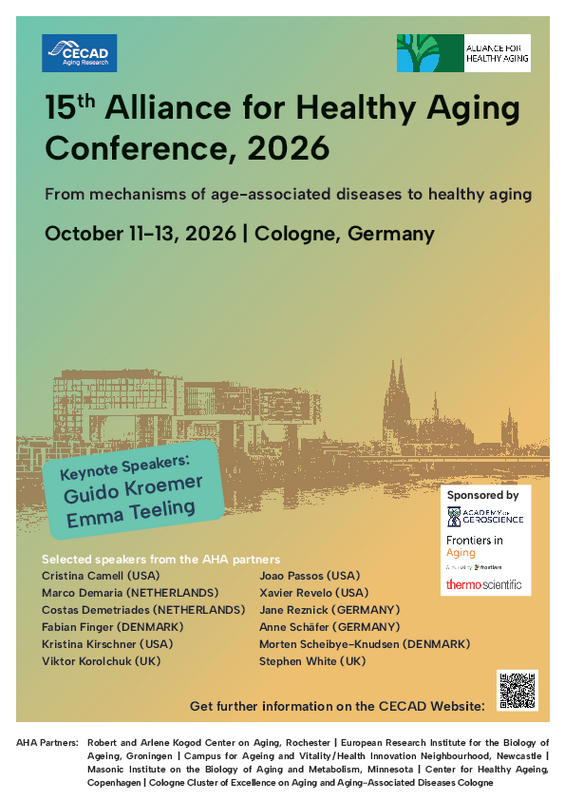
15th Annual Alliance for Healthy Aging Conference
From mechanisms of age-associated diseases to healthy aging
Each year, a conference is organized for scientists, clinicians, engineers, and students to exchange research results and ideas on translational research on aging. These meetings foster research collaborations, act as a springboard for new research grants and directions, and accelerate the translation of scientific discoveries to clinical practice by bringing together an expert and interdisciplinary panel with unique clinical, scientific, and commercial perspectives.
When & Where:
Date: 11th - 13th October 2026
Venue: MPI for Biology of Ageing & CECAD Research Center, Cologne, Germany
Organisatory Guidelines
Poster:
Please bring a printed version of your poster to the conference.
Poster format: max. 841 × 1189 mm (A0), portrait orientation only.
You will receive necessary materials for attaching your poster to the
designated presentation walls at the registration desk.
The Poster session takes place in the CECAD building.
Posters have to be mounted by Monday, 12.10.2026, from 12:00 to 16:15 at the latest.
Posters have to be demounted by Tuesday, 13.10.2026, until 12:45 at the latest
A detailed floor plan will be provided on the website and is also available at the registration desk during the conference.
Poster flash talks (selected only):
Poster flash talks are scheduled for max. 4 minutes.
Please prepare max. 1-3 slides for your flash talk presentation.
Please hand over your presentation as PDF file on a USB-Stick at the registration desk on Monday 12.10.2026, until 16:15 at the latest.
Posters also have to be mounted by Monday, 12.10.2026, from 12:00 to until 16:15 at the latest.
Posters have to be demounted by Tuesday, 13.10.2026, until 12:45 at the latest.
Talks:
Time slots scheduled for different talks:
Selected by abstract: 10 minutes presentation and 5 minutes discussion
Invited speakers: 15 min presentation plus 5 min discussion.
Keynote speakers: 35 min presentation plus 10 min discussion
We kindly ask you not to extend your presentation time due to the tight schedule.
Technical information for speakers:
Due to the tight schedule and the technical options of the MPI lecture hall, we would like to upload your presentations in advance on a central server.
Presentations where you use your own laptop should be an exceptional cases—that is, if not all of your presentation data can be fully transferred.
All presentations will be delivered using a Windows computer. If you wish to include videos in your presentation, please note that these cannot be played with sound.
We kindly ask that you to provide your presentations on a USB stick at the reception desk in advance of your session, if possible the previous day.
We will have Windows computers available at the reception desk where you can check whether your presentation plays as planned.
Due to the high demand, all presentations from the Max Planck Lecture Hall will be streamed via zoom to an additional seminar room in the CECAD building, which offers space for 50-60 people.
Your presentations will not be recorded, and your files will be deleted after the event.
If you have any questions, please feel free to contact the reception desk on-site or send us an email at cologne-aha[at]uni.-koeln.de in advance.
Public Transport tickets:
Public transport ticket will be provided at the registration desk. They are for free for those who ordered a ticket during registration.
Meals and Drinks:
Participants have all meals and drinks covered during the breaks as outlined in the conference programm.
Hotel Booking
Click on this link to find hotel recommendations via the booking tool by Kuoni Tumlare:
Program
Sunday, October 11th
| CECAD Foyer and Lecture Hall | ||
| 16:00 – 20:00 | Registration | |
| 17:00 – 19:00 | Trainee Round Table Event | |
| 19:00 - 21:00 | Welcome Reception | (by registration only) |
Monday, October 12th
| Max Planck Institute for Biology of Ageing – Foyer | |||
| 8:00 - 18:30 | Registration | ||
| Max Planck Institute for Biology of Ageing – Lecture Hall | |||
| 09:00 – 09:15 | Welcome Statements | Björn Schumacher, CECAD Cologne | |
| 09:15 – 10:00 | Keynote Lecture | Emma Teeling, University College Dublin | Repair, remove, resist: How do bats achieve extended healthspans? |
| Session 1: Metabolism/Proteostasis/Nutrition | Chair | Björn Schumacher | |
| 10:00 – 10:20 | Invited Speaker | Constantinos Demetriades, University Medical Center Groningen | Spatial Organization of Nutrient Signaling to mTORC1 |
| 10:20-10:35 | Brecht Attema, ERIBA, University Medical Center Groningen | Elevated plasma bile acid levels are associated with cardiac alterations in mice and men | |
| 10:35-10:50 | Joris Demmers, CECAD, Cologne | Transcription speed is controlled by mTOR via the super elongation complex | |
| 10:50-11:05 | Kazuto Kawamura, Max Planck Institute for Biology of Ageing, Cologne | Restoration of biological age during prolonged fasting-refeeding mediated by a fasting-responsive linker histone | |
| 11:05-11:20 | Ingrid van der Pluijm, Erasmus University Medical Center, Rotterdam | XPG deficiency accelerates vascular aging via VSMC phenotypic switching and metabolic dysfunction, which is mitigated by dietary restriction | |
| 11:20-11:35 | Seda Koyuncu, CECAD, Cologne | The aging factor EPS8 induces disease-related protein aggregation through RAC signaling hyperactivation | |
| 11:35-11:50 | Jonas Martin Schmidt, Goethe University Frankfurt | Spatiotemporal Proteostasis Rewiring In Senescence Progression Revealed By Translatome & Mitochondrial Importome Analyses | |
| 11:50-12:05 | Kathrin Ulrich, Saarland University, Saarbrücken | A redox-regulated chaperone in inter-tissue proteostasis regulation maintains a functional proteome and promotes healthy aging | |
| 12:05 – 13:15 | Lunch Break | ||
| Session 2: Senescence | Chair | Gavin Richardson | |
| 13:15-13:35 | Invited Speaker | Marco Demaria, University Medical Center Groningen | Purinergic signaling reinforces an inflammatory SASP and promotes senescence-associated dysfunctions |
| 13:35-13:50 | Daniela Costa, Robert and Arlene Kogod Center on Aging, Mayo Clinic, Rochester | Tomatidine is a senotherapeutic compound that improves cognitive function and reduces cellular senescence in aged mice | |
| 13:50-14:05 | Helene Martini, Mayo Clinic, Rochester | Mitochondrial metabolism and epigenetic crosstalk in senescent cells | |
| 14:05-14:20 | Allancer Nunes, University of Minnesota | Agonists of extra-oral bitter taste receptors suppress cellular senescence and enhance GLP-1 secretion | |
| 14:20-14:35 | Lilian Sales Gomez, Mayo Clinic, Rochester | Cellular Senescence in the Aging Liver Contributes to Cognitive Decline - Crosstalk between Liver and Brain | |
| 14:35-14:55 | Invited Speaker | Joao Passos, Mayo Clinic, Rochester | Mitochondrial nucleic acids: drivers of Inflammaging |
| 14:55-15:10 | Markus Schosserer, Medical University of Vienna | Exploring ribosomal RNA modifications and corresponding snoRNAs in human skin cell senescence | |
| 15:10-15:25 | Boshi Wang, ERIBA, University Medical Center Groningen | Sexually dimorphic expression of FABP5 favors tissue persistence of chemotherapy-induced senescence in male mice | |
| 15:25-15:45 | Invited Speaker | Xavier Revelo, University of Minnesota | Cellular Senescence in Macrophages: Implications for Aging and Disease |
| 15:45 – 16:15 | Coffee Break | ||
| Session 3: DNA | Chair | Lene Juel Rasmussen | |
| 16:15-16:30 | Arturo Bujarrabal-Dueso, Institute for Genome Stability in Aging and Disease, CECAD, Cologne | A Novel H2A.Z-Dependent Mechanism Underlies DREAM Complex Regulation of the DNA Damage Response | |
| 16:30-16:45 | Taiyu Ge, Institute for Genome Stability in Aging and Disease, CECAD, Cologne | Vitamin B12 boosts H3K4me2 deposition to promote transcription recovery following DNA damage | |
| 16:45-17:00 | Isabela Santos Valentim, Leibniz-Institut für Alternsforschung- Fritz-Lipmann-Institut, Jena | DREAMing of Healthy Aging: Deciphering the Molecular Links Between Sleep, Circadian Rhythms, and Cellular Repair | |
| 17:00-17:15 | Ilze Skujina, University of Galway, University College Dublin | Rapid DNA double-strand break repair as a candidate mechanism of exceptional longevity in the bat Myotis myotis | |
| 17:15-17:30 | Seunghwa Woo, Mayo Clinic, Rochester | Telo-CUT: A Telomere-Specific DNA Damage Model Reveals Drivers of Aging | |
| 17:30-17:50 | Morten Scheibye-Knudsen, University of Copenhagen | Data driven interventions in human aging | |
| 17:50 – 18:15 | Break | ||
| CECAD Research Center, Foyers and 1st floor | |||
| 18:15 – 22:00 | Poster Session with food & drinks | ||
| Poster flash talks, 11 talks (4 minutes) | |||
| Maarouf Baghdadi, Max Planck Institute for Biology of Ageing, Cologne | The combined treatment with rapamycin and trametinib partially recapitulates the in vitro molecular effects of genetic variants identified in exceptionally long-lived individuals | ||
| Mengyuan Cai, Erasmus MC, Rotterdam | Epigenetic Aging Indicators are Associated with Bone Mineral Density in a Population-Based Setting | ||
| Ariel Eraso, Senckenberg, Translational Biodiversity Genomics, Frankfurt | Aggregate Lifespan Encyclopaedia (ALE) - A new way to record animal lifespans | ||
| Ana Catarina Franco, Mayo Clinic, Rochester | A Spatial Multi-Omic Atlas of Cellular Senescence in Mouse and Human Skin | ||
| Angelina Job Kolady, CECAD, Cologne | Unravelling the role of H3K4me2 in response to DNA damage and transcription stress during development and ageing | ||
| Sandeep Kumar, Chulalongkorn University, Bangkok | Hesperidin and Melatonin Synergistically Enhance Longevity and Mitigate Amyloid-β Toxicity Through ACR-16–Dependent Activation of DAF-16/NRF2 Driven Autophagy | ||
| Joelina Lienau, University of Copenhagen | Old muscle, new rules: muscle derived FGF21 drives systemic resistance to protect failing muscle | ||
| Christos Mavrommatis, University of Cologne / Mayo Clinic, Rochester | Methylation-associated Gene Expression (MaGE) proxies of cellular senescence: scalable systemic senescence biomarkers in relation to disease severity and 174 incident disease outcomes. | ||
| Ayesha Sanober, IMB gGmbH, Mainz | Accelerated aging is a determinant of arterial thrombosis risk in individuals with low genetic and cardiovascular risk factor burden | ||
| Attila Sebe, University of Oulu | Lower blood cell mitochondrial DNA amount and inflammation associates with higher all-cause mortality and aging: a 30-year prospective epidemiological study | ||
| Feixiang Yan, Mayo Clinic, Rochester | A ttntv cardiomyopathy model in African Turquois Killifish enables identification of aging hallmark-associated gerotherapeutic strategies | ||
Tuesday, October 13th
| Max Planck Institute for Biology of Ageing – Foyer | |||
| 08:00 – 18:30 | Registration/Information | ||
| Max Planck Institute for Biology of Ageing – Lecture Hall | |||
| Chair | Paul Robbins | ||
| 09:00 – 09:45 | Keynote Lecture | Guido Kroemer, Université de Paris Cité | ACBP/DBI: a pro-aging danger signal |
| Session 4: Immunology | |||
| 9:45-10:05 | Invited speaker | Christina Camell, University of Minnesota | Chronic inflammation and organ dysfunction driven by an ageing immune system |
| 10:05-10:20 | Drake Alton, Robert and Arlene Kogod Center on Aging, Mayo Clinic, Rochester | Immune CD38 Overexpression Drives Systemic NAD Depletion and Physiologic Decline | |
| 10:20-10:35 | Claudia Chini, Robert and Arlene Kogod Center on Aging, Mayo Clinic, Rochester | Inducible Chronic NAD Deficiency in Mice drives Inflammation and Cellular Senescence | |
| 10:35-10:50 | Mauro Corrado, University of Cologne / CECAD | Suppression of T Cell–Driven Type I Interferons in Ageing Reveals Gut-Specific Vulnerability | |
| 10:50-11:05 | David Achudhan, Mayo Clinic, Rochester | MMP12 drives senescence-related bone loss via the cGAS-STING pro-inflammatory pathway | |
| 11:05-11:20 | Kavya Gupta, Mayo Clinic, Rochester | Rejuvenating the Aging Bone Marrow Niche to Mitigate Clonal Hematopoiesis via GLP-1 Mediated HSPCs Regeneration | |
| 11:20 – 12:45 | Lunch Break | ||
| Session 5: Neuroscience | Chair | Folkert Kuipers | |
| 12:45-13:05 | Invited speaker | Anne Schäfer, MPI Age, Cologne | Immunoregulatory Microglia in Alzheimer’s Disease |
| 13:05-13:20 | Allessandro Gialluisi, LUM University, LUM University, Casamassima & IRCCS Neuromed, Italy | Independent influence of multidomain aging clocks on cardio- and cerebro-vascular risk: evidence from an Italian population cohort | |
| 13:20-13:35 | Sara Graves, Mayo Clinic, Rochester | Sex-specific benefits of p21 knockout in PS19 tauopathy female, but not male, mice. | |
| 13:35-13:50 | Amanda Latham, Mayo Clinic, Rochester | Characterizing Cellular Drivers of Cognitive Decline Across the Aging Mouse Hippocampus | |
| 13:50-14:05 | David Meyer, CECAD Cologne / University of Cologne | Aging clocks delineate neuron types vulnerable or resilient to neurodegeneration and identify neuroprotective interventions | |
| 14:05-14:20 | Allyson Palmer, Mayo Clinic, Rochester | Delirium and Long-Term Cognitive Trajectories in Cognitively Normal Older Adults: Insights from the Mayo Clinic Study of Aging | |
| 14:20-14:35 | Yossawat Suwanlikit, Robert and Arlene Kogod Center on Aging, Mayo Clinic, Rochester | DNA Methylation-Based Clonal Hematopoiesis Burden Associates with Structural Brain Atrophy | |
| 14:35 - 15:15 | Coffee Break | ||
| Session 6: Physiology | Chair | Nathan LeBrasseur | |
| 15:15-15:35 | Invited speaker | Simon Tual-Chalot, Newcastle University | ADAR2 drives atherosclerosis by controlling metabolic inflammation |
| 15:35-15:55 | Invited speaker | Kristina Kirschner, Mayo Clinic, Rochester | One clone, many diseases: blood mutations and the ageing body |
| 15:55-16:10 | Andrea Heinz, University of Copenhagen | Elastin remodeling and elastokine signaling in aging tissues | |
| 16:10-16:25 | Eduardo Chini, Mayo Clinic, Rochester | NAD⁺ as a Therapeutic Lever for Renal Resilience in Perioperative Acute Kidney Injury | |
| 16:25-16:40 | Walter Sandt, CECAD, Cologne | Evolutionary conserved diapause mechanisms of slowed aging and rejuvenation | |
| 16:40-17:00 | Invited speaker | Fabian Finger, University Copenhagen | Mitochondrial membrane lipid cardiolipin controls fiber-type adaptations in aging muscle via ERRγ |
| 17:00-17:20 | Invited speaker | Jane Reznick, CECAD, Cologne | Young at Heart: neoteny and regeneration in the naked mole-rat |
| 17:20-17:45 | Concluding remarks | ||
| 17:45-18:45 | AHA Member Meeting | (only by invitation, Sem 1, MPI AGE) | |
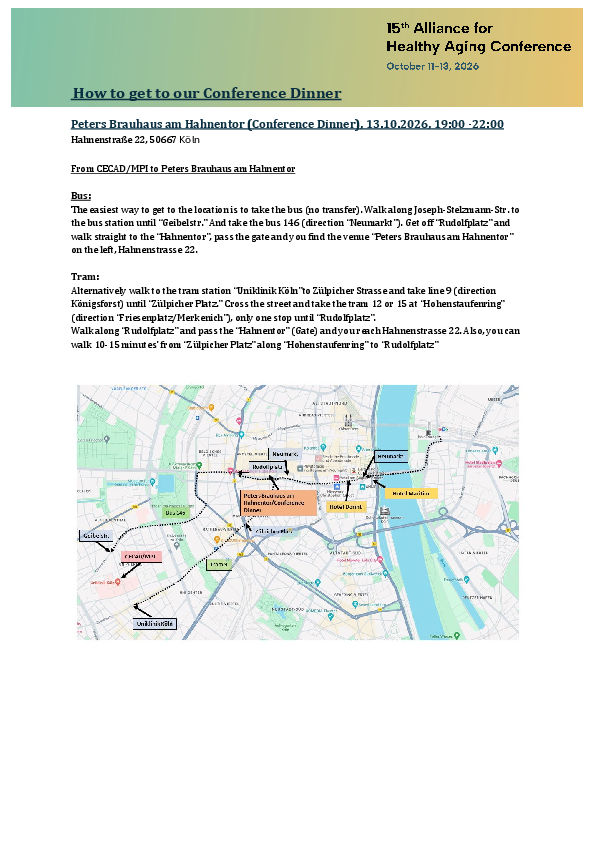
Cologne Brauhaus (by registration only) | |||
| 18:30 – 22:00 | Conference dinner | ||
The AHA Partners:
Robert and Arlene Kogod Center on Aging, Rochester | European Research Institute for the Biology of Ageing, Groningen | Campus for Ageing and Vitality / Health Innovation Neighbourhood, Newcastle | Masonic Institute on the Biology of Aging and Metabolism, Minnesota | Center for Healthy Ageing, Copenhagen | Cologne Cluster of Excellence on Aging and Aging-Associated Diseases Cologne
Venue
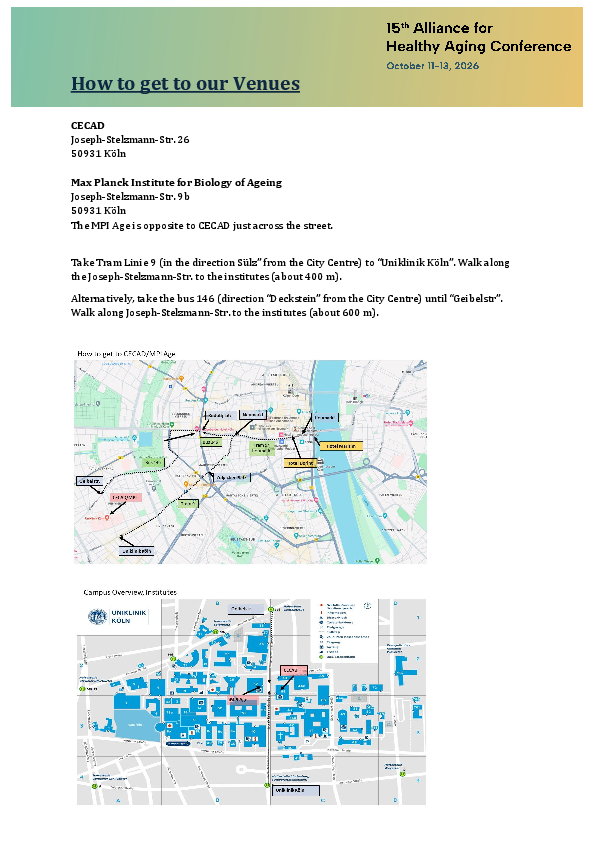
Max Planck Institute for Biology of Ageing
Joseph-Stelzmann-Str. 9B
50931 Cologne
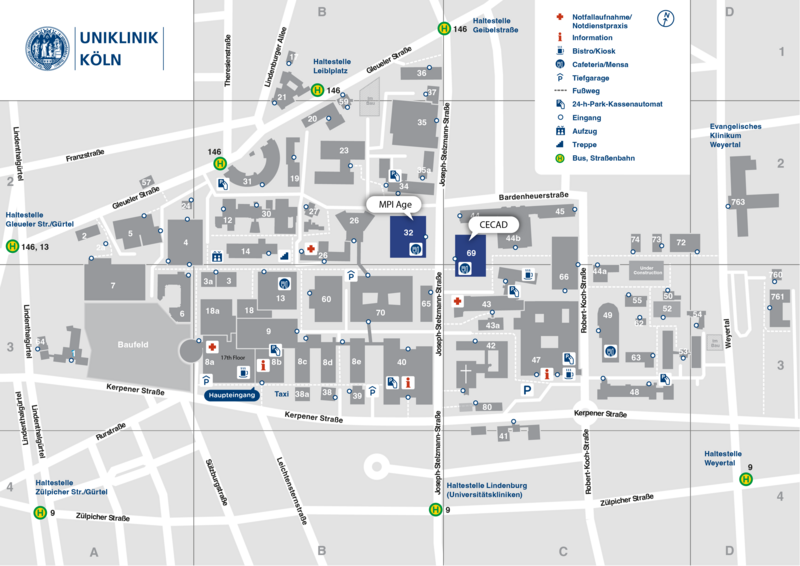
Download here a map of the University Hospital campus.
(32) Max Planck Institute for Biology of Ageing
(69) CECAD Research Center
Sponsored by

Interested in the Alliance for Healthy Aging?
Here you get to their website: LINK